Lithuania’s approach to mobile phone bans in schools
Much of Europe has introduced increasingly strict rules on mobile phones in schools, with studies – and even TV shows – showing the worrying effects of too much screentime, especially at a time when our children should be focused.
However, in Lithuania there are no plans for a universal ban on smartphones, nor common guidelines on what to do about phones. Education Minister Raminta Popovienė has stated that;
“If we see a widespread demand and schools struggling to set their own rules, then we will propose common rules that schools can use. At the moment, there is no such need.”
This is despite increasing UNESCO’s Global Monitoring Report on Education specifically recommending phones to be used in the classroom only when they are needed for learning. As a result, there’s bene a rise of lockable phone pouches used in the classroom around the world.
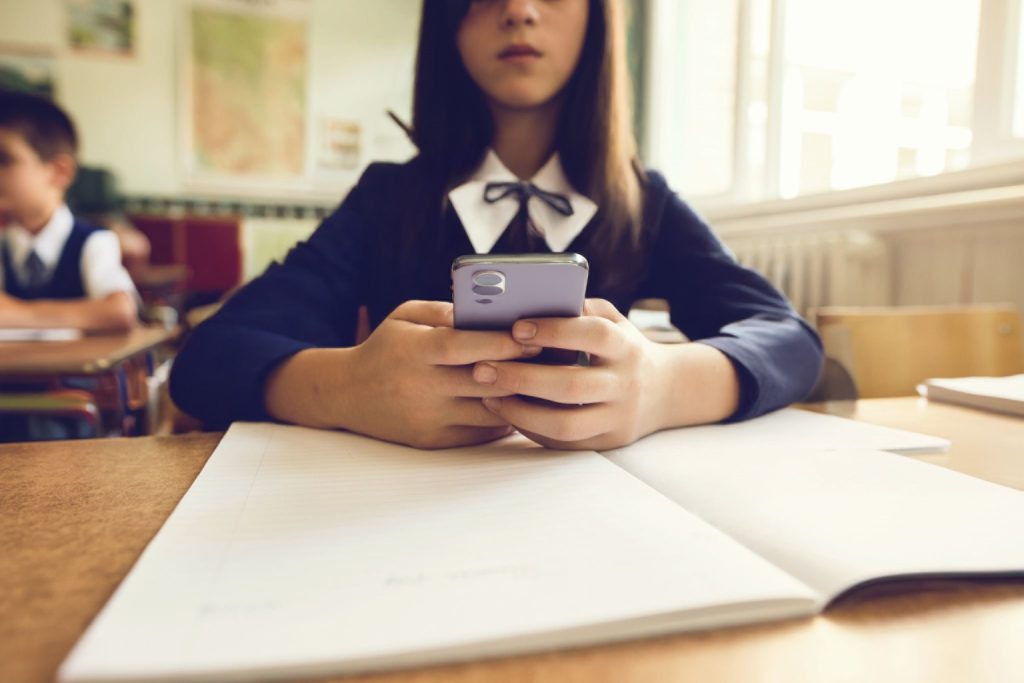
Closer to home, research in Lithuania backs up the need to take real steps to balance screentime. Dr Indrė Bakanienė, head of the Child Rehabilitation Clinic in Kaunas, commented;
“If a person is exposed to screens very early – in the first, second, third year of their life – there appear signs that are reminiscent of autism, there’s even the term ‘screen autism’, children start to behave like they’re autistic, they can’t concentrate, they’re very impulsive.”
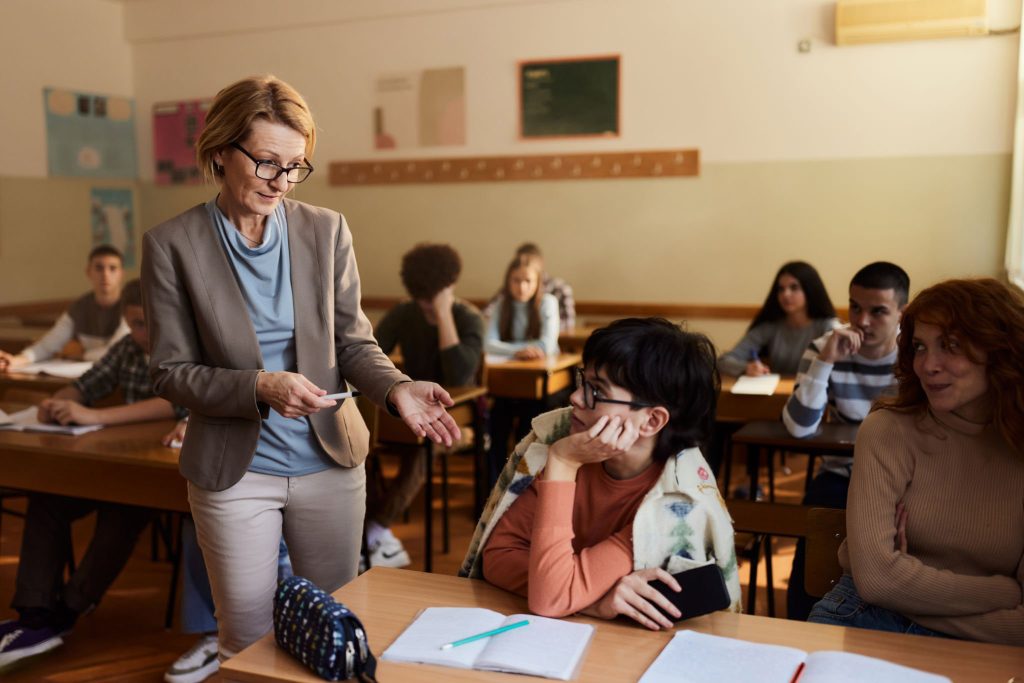
That’s not to say that schools in Lithuania haven’t taken any action, with some requesting that students leave their phones in boxes as class begins, a practice that has been in place for some years already.
However, there are confusing claims that phone bans don’t work, despite the apparent advantages.
Ilona, researcher at Vytautas Magnus University (VDU) in Kaunas, agrees that phones are a distraction, but studies carried out in schools show that bans do not always work. Around 1 in 5 students say they still use their phones during lessons despite the bans.
The key difference with the findings is that it’s not that phone bans don’t have a positive impact; it’s just a case of them not being implemented effectively.
Tandzegolskienė-Bielaglovė went on to say that “we should look for a solution that suits both sides. It would entail defining certain zones where students can use their phones, during breaks, and specific lessons during which mobile phones can be used.”
However, with Phone Locker®, the solution already exists, and is in place at schools across over 20 countries globally already.
What is Phone Locker?
Phone Locker® is a magnetic lockable phone pouch. Students are provided with their own pouch, and at the start of a school day, they place their phones inside the pouch and close it.
With the pouch closed, it cannot be opened without a special unlocking magnet. This can be in the form of a handheld device provided to teaching staff, or at a designated station at exits.
The advantage is this means flexibility – students can still access their phones at appropriate times. It also means they retain possession of their devices, avoiding liability issues for schools, and potential arguments with teachers!
At Phone Locker®, we work with schools on an individual basis to ensure that implementation works for their exact needs. We provide support, not only in installation, but achieving buy-in with parents, staff and students.





 English
  Spanish
  Portuguese
  French
  Italian
  German
  Chinese